We lost a great poet this week. Maya Angelou, whose brilliance in writing, activism, and just plain straight-out living left us gasping in admiration, has been described as a "global renaissance woman."
And how.
Worthwhile to take the time to trace that extraordinary life through Stamps, Arkansas, to Egypt, to Ghana, and beyond.
And even more worthwhile to listen to the poet's voice, her testimony to what she learned about our humanity through her world travels and her extraordinary gift for living.
You can read the poem, "Human Family," but I suggest you listen instead.
Well, perhaps not every book about Africa has the same cover. But Simon Stevens of Columbia University collected and offers as evidence quite a boat-load here, enough to make you ask why Africa's design short-hand has to be an acacia tree against a dramatic sunrise/set just . . . so many times. And it was his brilliant graphic and comment that got this discussion going most recently.
It's not the first time publishers have been called out for stereotypical images on their book covers. (Take a look at this post about how publishers package translations of Middle Eastern books.) Nor will it be the last. But is there anything we, as teachers, can make of such a discussion?
Don't judge a book by its cover, we've been told. But the cover (including the title and author) is the first piece of information a book offers us. That cover is intended to have an effect on us--i.e., "ooh, I must buy this book!" The images publishers choose are meant to connect with us emotionally and aesthetically as well as intellectually to produce this "ooh, I must buy this book!" effect. So the question the Africa is a Country post raises is, do publishers actually think that "Africa" can be positively linked in our hearts and minds to only one image (h/t @meowmusiq) ?
It's time to include book covers in book discussion. Not as an add-on or extra credit option, but as an essential part of coming to terms with a literary work. Maybe whenever we give students a book (especially a popular one) we should assess that book's cover, ask ourselves and our students why that particular design might have been chosen. What does it tell us about the story inside, even before we've opened the book? Do they think the image works? Or would they have chosen a different design?
Teachable moments. There are just so many of them.
Lately, we've been inundated with images and memories of the 1964 World's Fair in New York. Understandable, since it's the fiftieth anniversary of "the Fair" (as organizer Robert Moses insisted everyone call it in his hearing). As a predictor of the future, it was so-so. Yes, we're all tapping away at computers (then imagined as necessarily ginormous), but no jet packs. Not yet, anyway. (Too many Belgian waffles, maybe?)
Despite the publicity, it wasn't even officially a World's Fair. Because the Fair violated several international guidelines on the length of the exhibition, scheduling, and fee charging, the Bureau of International Expositions in Paris refused to sanction it. And on top of that (probably because of that), a disappointingly low number of countries actually participated. The Soviet Union declined (okay, it was the Cold War). Indonesia came, but withdrew (again, political tensions). But Canada and Australia didn't show up, and most of Western Europe gave it a pass. When both Germanys gave the Fair the cold shoulder, a "West Berlin" exhibit suddenly popped up. Guess that showed 'em.
Oh, well. The party went on anyway. And the international theme was carried forward most memorably by America's number one showman, Walt Disney, in the exhibit "It's a Small World."
Here's the charming story of how it happened. Pepsi-Cola, overwhelmed with respect and love for the world's children, hired Disney to create a ride/show in honor of UNICEF. The promise--to celebrate the children of the world in each culture, and globally.
And here's the result.
To be honest, I have to admit that when I recall seeing "It's a Small World" at the Fair as a child, all I remember is the experience of total sensory overload. That, and the child seated in front of me, who kept asking "when can we get out?" At one point, she leaned toward a nodding and dancing animatron and screamed "I hate you!" So much for peace through understanding. But I'm sure they sold a lot of Pepsi.
Now, of course, all I can see is the almost unbelievable cultural craziness in this round the world tour. "The wooden-shoe children of Holland"? Really? And "exotic Asia," of course, with its mish-mash of China and Japan, followed up by flying carpets over the Taj Mahal. And "the mysterious dark continent of Africa." And let's just stop there.
Because we could go on and on about how clueless we all were fifty years ago. The point it, where are we now? How do we introduce our young students to their peers around the world? Is it any deeper and more authentic an experience than a ride through a tunnel populated by animatronic dolls?
So grateful to our First Lady Michelle Obama for the strong support of global education during her visit to China. Here's what she said at Peking University:
"Studying abroad
isn’t just a fun way to spend a semester; it is quickly becoming the key to
success in our global economy. Because getting ahead in today’s workplaces
isn’t just about getting good grades or test scores in school, which are
important. It’s also about having real experience with the world beyond your
borders -- experience with languages, cultures and societies very different
from your own."
You can watch the video of the First Lady's talk here. And let me ask you--when will "global education" finally be just "education"?
Alright, I'll admit it. I've had a hankering to be one of those Disney Princesses since I was three years old. (This despite the face that I nearly fell down the stairs in the clear plastic Cinderella shoes I'd pleaded for.)
Of course, I had my reservations. Don't we all? But here's a video that may bring even the most reluctant Disney-disapprover into the fold.
Yes, that's Elsa from Frozen, singing her "I'm-going-my-own-way" song in twenty-five different languages. Play this one at home or in your class for young girls and then casually mention taking a closer look and listen to one of the languages Elsa is singing. I'll bet you get some interest.
If you're a teacher or a parent (or an aunt!) wanting to use this fun for global learning, you'll find some great ideas for research and discussion at Nat Geo's Blog
And ten years from now, watch out for the Daughters of Elsa world language students and speakers.
Hi. Good to be in touch. Listen, I'm not going into all the global warming business right now (although I do wish you'd pay a little more attention to it). Today I have one very simple but very vital reminder for you.
There is no up and down in space.
Okay, so what does that mean? Lots of things, but most important to what I'd like to think about today is that you're thinking of the way I look in only one way instead of many ways.
Don't get me wrong--I'm really flattered that you think of me so often, and create such beautiful images of me. That Universal Studios logo at the beginning of their movies?
Fantastic. Love it. But you know it's kind of Western-hemisphere centric, right? Yeah, we covered that a while back. But also--well, something you may not have thought of.
How shall I put this, because it may be pretty strange to hear. Ummm. There is no up and down in space.
So . . . Well, that North Pole is at the top stuff? Not really. I mean not all the time. And don't get me wrong, I love the NASA photo of Earth from space.
But. It could have been the other way (I mean "upside down") and been just as accurate.
Yeah, freaky.
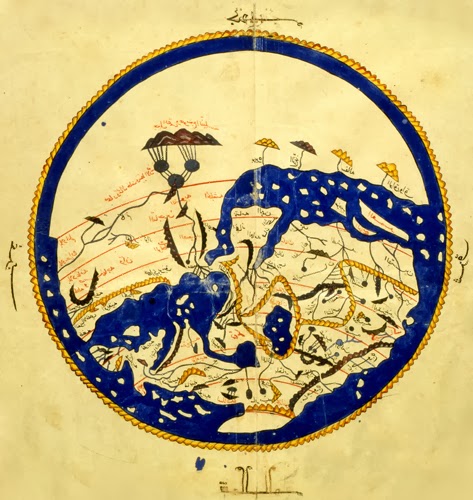
Take a look at this beautiful map of a region I know you're very familiar with. Muhammad Al-Idrisi created it in the 12th century.
Can't place it? How about if we turn it "upside down."
Now you see it. Well, both are equally accurate. You see?